Complete visibility into
the shot blasting process.
Blast intensity. Abrasive consumption. Cycle performance. Surface finish outcomes.
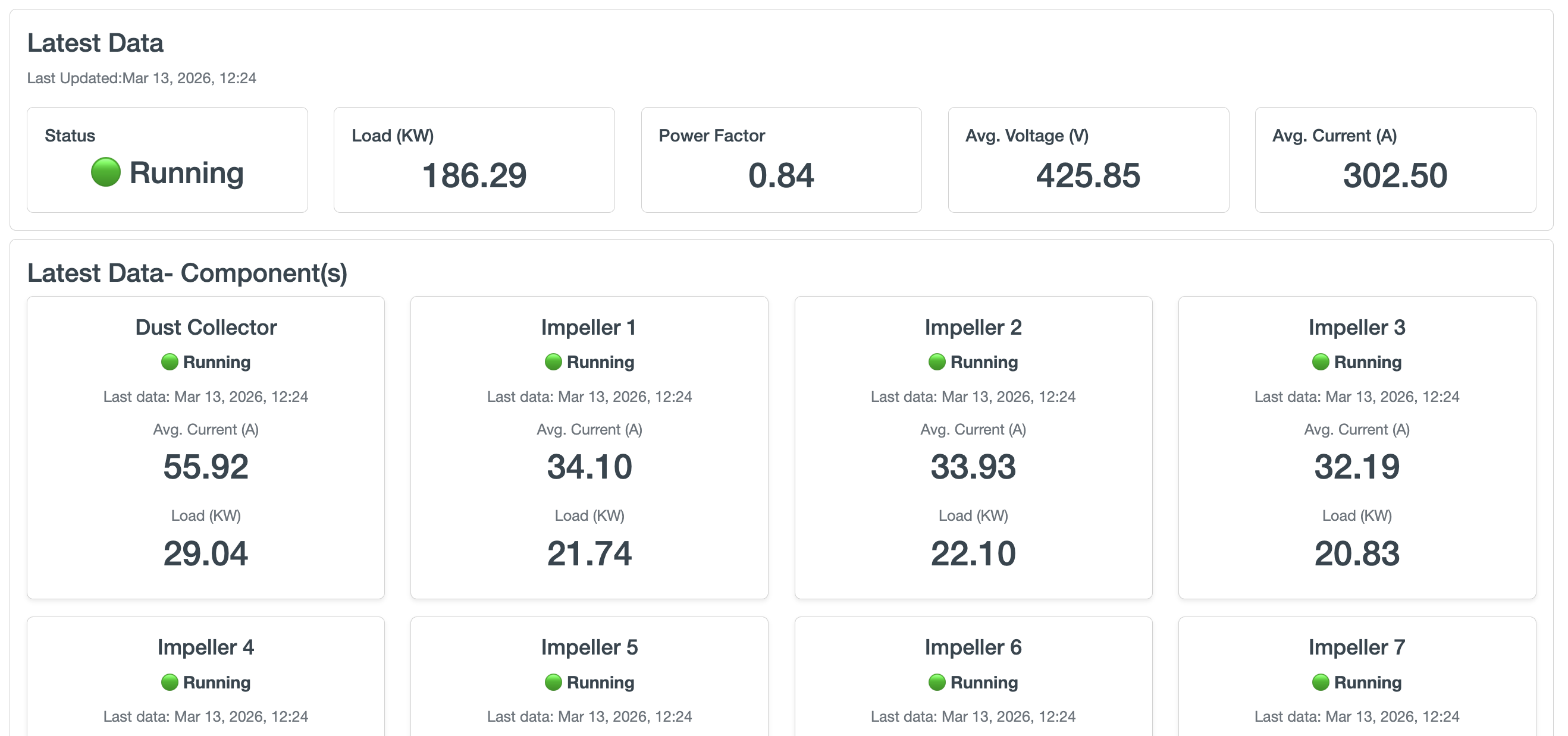
Shotblast360 instruments every variable in the shot blasting process — and makes them visible, in real time, across every machine and every shift.
Problems Solved
The problems that hit your output and costs
Shot counts and cycle data buried in operator registers
Shotblast360 surfaces production data in real time — output by shift, machine, and job, with trends over time.
Cycle times vary across shifts — no one knows by how much
Every cycle detected from wheel motor load signatures. Duration benchmarked automatically — outliers visible immediately.
Shift-wise comparison requires pulling registers from multiple operators
Compare throughput, cycle count, and abrasive usage across shifts — automatically, without a spreadsheet.
Abrasive tracked in bags added — never per unit of output
Shotblast360 calculates abrasive consumption per basket or per tonne — and tracks how it moves across machines and shifts.
No baseline for normal abrasive consumption on a given product
Every cycle adds to your baseline — so drift from degraded separators or worn liners is visible before it shows up in your purchase orders.
Over-consumption attributed to product mix — not machine condition
Spot which machine or shift is driving excess use — and whether it correlates with wheel motor load drop or separator performance.
Impeller wear caught only at breakdown — not from load trends
Continuous wheel motor current monitoring detects load drop from blade wear and liner degradation — before it becomes a failure.
Machine availability calculated from memory at month-end, if at all
Running, idle, off — every state change logged automatically. True availability always visible.
Breakdown records on paper — no pattern analysis across machines
Every stop linked to its reason, duration, and frequency — patterns surface automatically.
Blast intensity deviations identified after the job is complete
When wheel load or blast parameters drift, Shotblast360 flags it mid-cycle — not after the surface finish has been compromised.
QC parameters recorded per job — no cross-job trend analysis
Track every inspection parameter across jobs — drift and deviations visible without digging through inspection registers.
Surface finish rejections not connected to the process that caused them
First Pass Yield and rejection rate linked to the machine, shift, and wheel condition at the time of production.
Shot counts and cycle data buried in operator registers — no trends, no benchmarks
Shotblast360 surfaces production data in real time — output by shift, machine, and job, with trends over time.
Cycle times vary across shifts — no one knows by how much
Every cycle detected from wheel motor load signatures. Duration benchmarked automatically — outliers visible immediately.
Shift-wise comparison requires pulling registers from multiple operators
Compare throughput, cycle count, and abrasive usage across shifts — automatically, without touching a spreadsheet.
Abrasive tracked in bags added — never per unit of output
Shotblast360 calculates abrasive consumption per basket or per tonne — and tracks how it moves across machines and shifts.
No baseline for normal abrasive consumption on a given product
Every cycle adds to your baseline — so drift from degraded separators or worn liners is visible before it shows up in your purchase orders.
Over-consumption attributed to product mix — not machine condition
Spot which machine or shift is driving excess use — and whether it correlates with wheel motor load drop or separator performance.
Impeller wear caught only at breakdown — not from load trends
Continuous wheel motor current monitoring detects load drop from blade wear and liner degradation — before it becomes a failure.
Machine availability calculated from memory at month-end, if at all
Running, idle, off — every state change logged automatically. True availability always visible.
Breakdown records on paper — no pattern analysis across machines
Every stop linked to its reason, duration, and frequency — patterns surface automatically.
Blast intensity deviations identified after the job is complete
When wheel load or blast parameters drift, Shotblast360 flags it mid-cycle — not after the surface finish has been compromised.
QC parameters recorded per job — no cross-job trend analysis
Track every inspection parameter across jobs — drift and deviations visible without digging through registers.
Surface finish rejections not connected to the process that caused them
First Pass Yield and rejection rate linked to the machine, shift, and wheel condition at time of production.
Five layers. One system.
Every component of the shot blasting process — instrumented, reported, analysed, and escalated from a single platform.
Digital Reporting from the Shop Floor
No paper registers. No end-of-shift backfilling. No data gaps between machines.
- Structured production reports — operators log job data on mobile at the machine: abrasive additions, job weight, cycle count, observations. Submitted and approved before the next shift begins.
- Maintenance activity logging — every repair, replacement, and inspection documented digitally with timestamp — linked directly to the stop event that triggered it.
- Surface finish inspection records — QC parameters entered against the job, machine, and shift — building a searchable, auditable quality history without manual filing.
- Supervisor approval workflow — reports require sign-off before they enter the analytics layer. Every entry is timestamped and attributed. No retroactive editing.
- Works on any device — phone at the machine, tablet on the floor, desktop in the office. No dedicated terminal required.
IoT-based Live Monitoring
Every cycle start and stop detected from motor load signatures — not from operator input.
- Wheel motor current monitoring — continuous amperage logging from the main panel. The primary signal for blast intensity, impeller health, and cycle detection.
- Automatic cycle detection — every production cycle identified from load signatures. Start time, end time, and duration logged without operator input.
- Machine state tracking — running, idle, and off states logged continuously. Every transition timestamped — the foundation for availability and utilization calculations.
- Multi-parameter support — conveyor status, dust collector operation, and other auxiliary signals can be monitored alongside wheel motor data depending on machine configuration.
- Retrofit, not replacement — sensors connect to the existing main panel. No machine modification required. Compatible with any wheel blasting machine regardless of age or manufacturer.
Real-time Anomaly Detection
Process drift caught mid-cycle — not after the job is done and the surface has been compromised.
- Impeller load drop detection — wheel motor current trending against configured baselines. Progressive decline from blade wear or liner degradation flagged before it affects blast quality.
- Cycle time overruns — every cycle benchmarked against the target duration for that job type. Outliers flagged automatically — indicating process variability, blockages, or operator delay.
- Abrasive consumption spikes — per-cycle consumption compared against the established baseline for that product. Sudden increases indicate operating mix imbalance or separator underperformance.
- QC parameter breaches — inspection readings monitored against configured upper and lower limits. Out-of-spec entries flagged at submission with severity classification.
- Unreported cycles — cycles detected by IoT with no corresponding operator report flagged automatically — closing the gap between machine activity and recorded production.
Automated Alerts & Escalation
The right person notified at the right severity — while there is still time to act.
- Multi-level escalation matrix — each alert type configured with up to three severity levels. Level 1 notifies the machine supervisor. Level 2 adds the department head. Level 3 reaches the plant head and maintenance head simultaneously.
- Mobile delivery — alerts pushed to the right person's phone with the exact reading, the threshold breached, and the recommended action — no dashboard login required to act.
- Configurable thresholds — alert levels set per machine and per parameter. Impeller amp thresholds reflect the specific wheel assembly. Abrasive baselines reflect the specific product and job type.
- Full alert log — every alert recorded with timestamp, reading, severity, and recipient. Searchable history for audit, maintenance planning, and root cause analysis.
Example — Impeller Amps Escalation
Live Analytics
No spreadsheet consolidation. No manual calculations. Every number current, every shift.
- OEE per machine — availability, performance, and quality calculated automatically from IoT and report data. Updated every shift, comparable across machines.
- Throughput and shift analysis — output by machine, product, shift, and period. Shift-wise comparisons without manual consolidation.
- Abrasive consumption per unit — trended over time with variance flagged. The number that sits at the centre of the TCO calculation — tracked automatically, not estimated monthly.
- Energy per unit of output — kWh per basket, tonne, or piece — per machine, per shift. Cross-machine comparison surfaces efficiency differences that facility-level metering cannot.
- Quality outcomes — First Pass Yield, rejection rate, and rework rate — trended by machine, job type, and period. Linked to the process data that explains them.
TCO — measured continuously,
not in an annual audit.
Abrasive is only 20% of the total cost of a shot blasting operation. The remaining 80% — energy, downtime, wear parts, manpower, waste — is largely invisible. Shotblast360 instruments every component of that cost, live, across every machine.
Total Cost of Operation — Where the cost actually sits
The 80% most plants can't see
Most plants track the price per kg of abrasive and stop there. But abrasive is only one line item. The larger costs — energy draw per cycle, unplanned downtime, accelerated wear part replacement, excess labour — only become visible when the process is fully instrumented.
Abrasive Consumption
Shotblast360 calculates abrasive consumption per basket, per tonne, and per piece — and benchmarks it over time. Drift from operating mix imbalance, separator wear, or incorrect top-up frequency is visible before it shows up in the purchase order.
Energy Consumption
kWh per unit of output — tracked continuously at machine level, not estimated from the facility meter. Cross-machine efficiency comparisons are possible for the first time. Abnormal energy draw from degraded impellers or overlong cycles is flagged in real time.
Machine Downtime
Every stop logged with timestamp, duration, and reason code. Availability calculated automatically per machine, per shift, per period. Repeat failure patterns surface before they become scheduled replacements or unplanned breakdowns.
Wear Parts
Wheel motor current is the leading indicator of impeller blade wear, liner degradation, and cage wear. Shotblast360 trends it continuously — so wear part replacement is driven by actual condition data, not fixed intervals or breakdown response.
Labour Efficiency
Cycle detection from IoT identifies idle time between jobs, unreported cycles, and shift-level output gaps — making operator productivity visible without manual tracking. Digital reporting replaces end-of-shift register filling entirely.
Waste & Rework
Surface finish rejections and rework are logged per job, linked to the machine state and blast parameters at time of production. First Pass Yield trends expose where process variability is costing the most — before it reaches the customer.
Where Shotblast360 is deployed
Shot blasting is critical to surface preparation across heavy industry. Shotblast360 instruments the process wherever it runs.
Iron & Steel Castings
Foundries use shot blasting to remove sand, scale, and oxide from cast components. Abrasive consumption and cycle consistency directly determine surface quality and cleaning cost per tonne.
Forged Components
Forging units blast components to remove scale and prepare surfaces for coating or inspection. Blast intensity uniformity is critical — under-blasting leads to coating failures; over-blasting causes dimensional loss.
Automotive Components
Chassis parts, suspension components, brake discs, and gears require tight surface finish tolerances. High-volume automotive lines demand consistent cycle times and abrasive efficiency across multiple machines and shifts.
Structural Steel & Fabrication
Steel beams, plates, and fabricated structures are blasted before painting or galvanising. Surface profile and cleanliness standards — Sa 2.5, Sa 3 — must be met consistently to avoid coating failures in the field.
Springs & Fasteners
Shot peening of springs and fasteners induces compressive residual stress to improve fatigue life. Process control here is safety-critical — coverage, intensity, and Almen arc height must be logged and verified for every batch.
Heavy Engineering & Infrastructure
Mining equipment, railway components, shipbuilding parts, and wind tower sections require large-scale blasting with high abrasive throughput. Machine availability and energy consumption per tonne are the primary operational metrics.
Give your shot blasting unit full visibility
From impeller amps to abrasive cost per unit — everything in one system.